What Does an Anode Rod Do and When to Replace It
The anode rod sacrifices itself so your steel tank does not rust. Here is how it works in Pahrump's hard water and when to replace it.
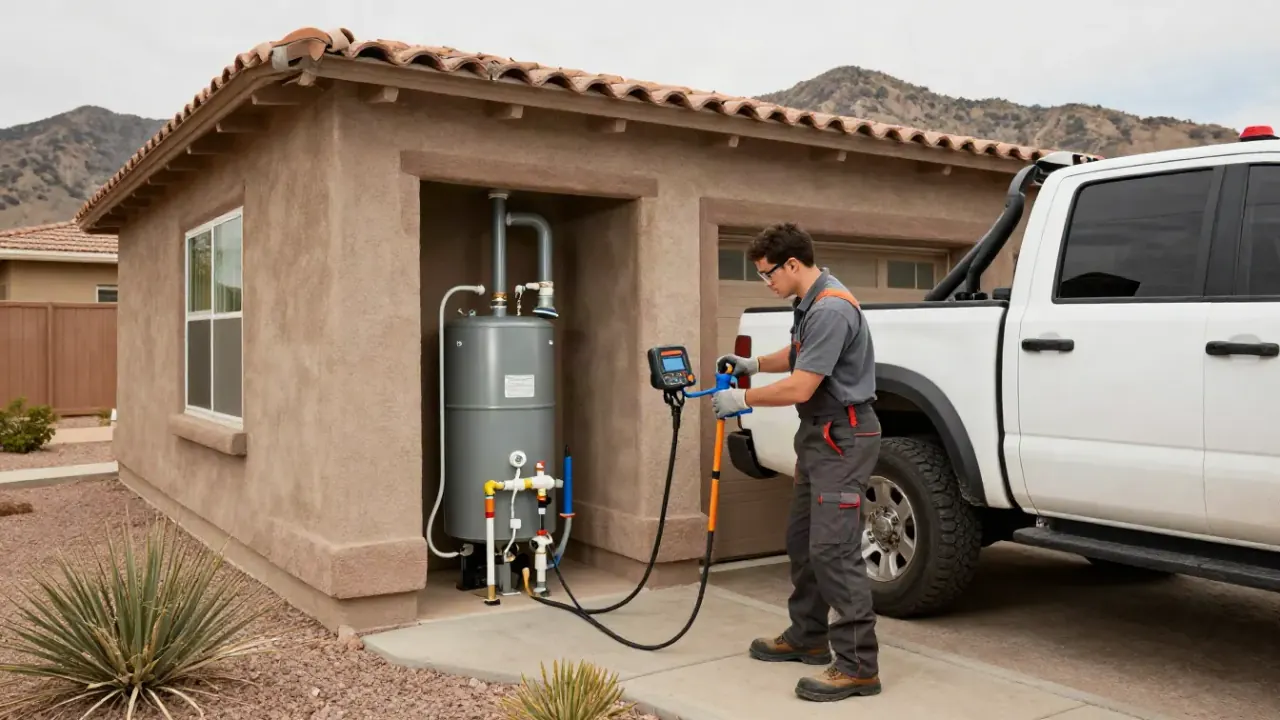
An anode rod is a sacrificial metal rod inside your water heater tank that corrodes instead of the steel tank walls, and you should replace it every 3 to 5 years in Pahrump - sooner if your water is especially hard. That is the whole answer. The rod is not a filter, it is not a heating part, and it does not affect how hot your water gets. It exists for one reason: to rust so your tank does not.
Most homeowners never think about it until the tank starts leaking from the inside out. By then the rod has been gone for a year or more and the damage is done. Here is how the rod works, why Pahrump water chews through them faster than most of the country, and what it costs to have one swapped out in 2026.
What an Anode Rod Actually Does
The anode rod function in Pahrump is identical to anywhere else: it creates a small electrical current inside the tank that pulls corrosion toward itself and away from the steel lining. Water heaters are made of steel, and steel plus water plus oxygen equals rust. The rod is made of a metal that gives up its electrons more easily - usually magnesium, aluminum, or a zinc-aluminum blend - so the electrochemical reaction attacks the rod first.
Think of it as a fuse. It burns out on purpose so the circuit behind it survives. A standard magnesium anode rod in a residential tank is about 3/4 inch thick and 40 to 44 inches long, and it will shed material steadily for years. Once it is down to the bare steel core wire - roughly the thickness of a coat hanger - it stops protecting anything.
Two things shorten that life dramatically: hot water and hard water. Both are constants here.
Why Pahrump Water Eats Anode Rods Faster
Pahrump sits on some of the hardest groundwater in Nevada, and hardness is measured in grains per gallon. Anything above 7 gpg is considered hard; much of the water feeding homes around the valley runs well past 15 gpg, and some wells push into the 20s. All that dissolved calcium and magnesium does two things to a water heater: it plates the tank and heating elements with scale, and it accelerates the electrochemical reaction that consumes the anode rod.
Heat makes it worse. A tank held at 140°F will consume its anode roughly twice as fast as one set to 120°F. Most Pahrump homes run hot water at 130°F to 140°F because it feels better in winter and stretches further in a big household - which is fine, but it means the rod is on a shorter clock.
We see the same pattern across the valley. In the older tract homes around Central Pahrump water heater repair calls, tanks that are 6 to 8 years old routinely show anode rods that are completely spent, with the core wire exposed and rust starting to bloom at the bottom of the tank. Newer builds on the south end of the valley are not immune - they just have a couple more years before the rod gives out.
If you want the full picture on how scale and sediment shorten tank life, our Anode Rod Replacement & Tank Flushing Pahrump NV service covers both the rod swap and the sediment flush that keeps the bottom of the tank from cooking itself.
When Should You Replace the Anode Rod in Pahrump?
Replace the anode rod every 3 to 5 years in Pahrump, or every 2 to 3 years if your water tests above 15 grains per gallon. That is the practical answer for this valley, and it is shorter than the 5-to-7-year window you will read about on national plumbing sites. Their numbers assume softer water and lower tank temperatures than what we actually deal with here.
Here is the schedule we give customers:
- Years 0-3: Rod is doing its job. Pull it and inspect at the 3-year mark.
- Years 3-5: Most Pahrump rods are 50% to 80% consumed. Replace now.
- Years 5-8: Rod is usually gone. Tank may already have rust pitting inside.
- Year 8+: If the rod was never changed, plan on a new tank rather than a rod.
The inspection itself is cheap. A technician pulls the rod from the top of the tank, wipes it down, and measures how much metal is left. If more than half the original diameter is gone, we replace it. If the rod is still thick and mostly intact, we put it back and check again next year.
One more thing: if your tank is already past 8 years old and the rod has never been touched, replacing it now is often a waste of money. The tank has been unprotected for years and the rust is already working. That is the point where Water Heater Replacement Pahrump NV makes more sense than throwing parts at a tank that is on borrowed time.
Signs Your Anode Rod Is Already Gone
The signs an anode rod needs replacement in Pahrump NV are not subtle once you know what to look for, but they are easy to miss if you never go near the tank. Watch for these:
- Rotten-egg smell in the hot water only. That is sulfur bacteria reacting with a depleted aluminum or magnesium rod. Cold water smells fine; hot water reeks.
- Rusty or metallic-tasting hot water. The tank lining is starting to give up.
- Popping or rumbling sounds. Usually sediment, but it often shows up alongside a dead rod because both come from the same hard-water problem.
- Water pooling at the base of the tank. This is late-stage. The tank has already rusted through.
- Rod is 6+ years old and never inspected. That alone is enough reason to have it checked.
If you are seeing rusty water or a puddle, stop running the unit and get it looked at. A leaking tank does not heal. Our Water Heater Leak Repair Pahrump NV team can tell you in one visit whether it is a fitting, a valve, or the tank itself - and whether a rod swap will buy you more years or whether you are looking at a replacement.
What Anode Rod Replacement Costs in Pahrump
Typical 2026 pricing for anode rod replacement in Pahrump runs $200 to $400 for a standard residential tank, including the rod, labor, and a basic flush. The rod itself is a $25 to $60 part. The rest is the work: shutting off the water and gas or power, draining the tank down, breaking loose a fitting that has been sitting in hard water for years, threading in the new rod with fresh Teflon tape and pipe dope, refilling, and relighting or re-energizing.
Two things push the price higher:
- Segmented rods. If your tank sits under a low ceiling or in a tight closet - common in the manufactured homes and older builds around the valley - a one-piece rod will not fit through the opening. A segmented rod costs more but goes in one section at a time.
- Stuck or seized anode port. On tanks that have never been serviced, the factory anode can be welded in place by corrosion. Getting it out without damaging the tank takes time and the right tools.
Compare that to $1,400 to $2,600 for a new tank installed, and the math is obvious. A $300 rod swap every 4 years is the cheapest insurance you can buy on a water heater.
Can You Replace an Anode Rod Yourself in Pahrump?
You can replace an anode rod yourself if you have a 1-1/16 inch socket, a breaker bar, a way to drain the tank, and enough ceiling clearance to pull a 44-inch rod straight up. Most Pahrump homeowners do not have that last one. The rod sits on top of the tank, and in a standard closet or under a low roof, there is simply no room to lift it out.
The other problem is torque. Factory anode rods are installed tight, and after years in hard water they seize. We have seen homeowners strip the hex head or crack the tank fitting trying to muscle one loose with a standard ratchet. Once that port is damaged, you are looking at a new tank, not a new rod.
If you do want to try it yourself, here is the honest version: shut off the water and the gas or power, attach a hose to the drain valve and drain 2 to 3 gallons (not the whole tank - you just need the water level below the rod), break the rod loose with a breaker bar, thread in the new one with Teflon tape, refill, and purge the air before you fire it back up. If anything feels wrong, stop.
For most people, having us do it is faster and safer. We carry the right rods for Pahrump water, we have the tools to get a seized one out, and we flush the tank while we are in there. If your tank is tankless instead of a standard tank, the maintenance picture is different - that is a descaling job, not a rod job, and you can read about it under Tankless Water Heater Flushing & Descaling Pahrump NV.
Common Mistakes We See on Anode Rod Jobs
The most common mistake is waiting until the tank leaks. An anode rod is a maintenance item, not a repair item. Once you see water on the floor, the rod has already failed and the tank has already lost the fight.
Other mistakes we run into:
- Using the wrong rod material. Magnesium is the standard choice, but in water with high sulfate content it can create that rotten-egg smell. Aluminum or zinc-aluminum rods are the fix. We match the rod to the water, not to whatever is on the shelf.
- Not flushing the tank at the same time. Pulling the rod without flushing leaves years of sediment sitting on the bottom, which shortens the life of the new rod and the tank.
- Overtightening the new rod. It needs to be snug, not gorilla-tight. Overtightening cracks the tank port.
- Forgetting to purge air. If you do not bleed the tank before restarting, you can burn out an upper heating element on an electric unit.
- Replacing the rod on a tank that is already rusted through. If the tank is leaking from the shell, the rod is irrelevant. That tank is done.
We see this most often in the older neighborhoods, where tanks have been in service for a decade with zero maintenance. If you are in one of those areas and want a straight answer on whether a rod swap is worth it, our Water Heater Repair in Calvada Valley team handles a lot of these calls and will tell you honestly whether you are looking at maintenance or replacement.
When to Call a Professional
Call a professional when the rod is seized, when you do not have clearance to pull it, when you smell sulfur in the hot water, or when the tank is already leaking. Those are the four situations where a DIY attempt usually turns a $300 job into a $2,000 job.
We handle anode rod service across the valley, including the tight closets and low-clearance installs that make DIY impossible. We pull the rod, inspect it, match the replacement to your water, flush the tank, and test everything before we leave. You get hot water back the same day and a tank that is protected again.
If you are not sure whether your rod has ever been changed, that is reason enough to have it looked at. It is a 30-minute inspection that can save you a tank.
Frequently Asked Questions
What does an anode rod do in Pahrump NV?
It sacrifices itself to corrosion so your steel tank does not rust. Pahrump's hard groundwater speeds that process up, so the rod typically lasts 3 to 5 years here instead of the 5 to 7 years you see quoted for softer-water areas.
When should I replace my anode rod in Pahrump?
Every 3 to 5 years, or every 2 to 3 years if your water tests above 15 grains per gallon. Have it inspected at the 3-year mark. If more than half the rod's original diameter is gone, replace it.
How much does anode rod replacement cost in Pahrump Nevada?
Expect $200 to $400 in 2026 for a standard tank, including the rod, labor, and a flush. Segmented rods and seized fittings push it toward the top of that range. A new tank installed runs $1,400 to $2,600.
Can I replace an anode rod myself in Pahrump?
Only if you have 1-1/16 inch tools, a breaker bar, and enough ceiling clearance to lift a 44-inch rod straight out. Most Pahrump closets do not have that clearance, and seized rods often crack the tank port when forced.
Does a bad anode rod affect water temperature?
No. The anode rod has nothing to do with heating. If your water is not getting hot, the problem is the element, thermostat, gas valve, or pilot - not the rod. That is a different diagnosis entirely.
Get Help With Water Heater Repair in Pahrump
If your tank is 3 years old or older and the anode rod has never been checked, we can inspect it, replace it, and flush the tank in a single visit. We work on gas, electric, and tankless units all over the valley.
Call Pahrump Water Heater Repair at (775) 551-1066 and we will get your tank protected before the rod gives out.